

Similar to many of U.S. President Donald Trump’s agreements, the deal he is currently promoting with China lacks substantial details and is heavy on exaggeration.
On Thursday, Trump characterized his encounter with Chinese President Xi Jinping as incredible, giving it a score of 12 out of 10. He informed journalists that China is set to purchase “huge quantities” of soybeans. In a post on social media, he hinted at the potential for “a very large scale transaction” involving oil and gas from Alaska.
However, examining Trump’s enthusiastic claims alongside the specific agreements made by the two leaders, analysts view this as more of a truce in the trade conflict between the two largest global economies rather than a definitive resolution to the tensions.
The official framework presented by the U.S. and China essentially signifies a retreat from some of the penalties and retaliatory threats exchanged since Trump resumed his presidency.
Dennis Wilder, a professor at Georgetown University and a senior fellow in its China Initiative, notes that the U.S. and China have been testing each other’s resolve over recent months, ultimately reaching a stalemate.
Wilder stated in an interview with CBC News on Thursday, “This represents a pause in the trade conflict. It does not signify the end of the trade war; we are still quite far from that.”
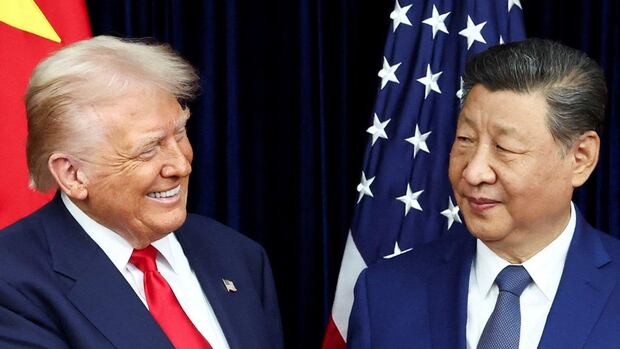
U.S. President Donald Trump claims he has reached an agreement with President Xi Jinping to reduce tariffs on Chinese imports in exchange for Beijing’s commitment to tackle the illegal fentanyl trade, resume purchases of U.S. soybeans, and maintain exports of rare earth minerals.
In return for Xi’s assurance to curb the distribution of chemicals utilized in fentanyl production, Trump consented to a 10 percentage point reduction in tariffs on China’s exports to the U.S. effective immediately.
“I believe the Chinese are genuinely taking strong measures,” Trump remarked to the media.
Canadians may observe that Trump is lowering tariffs on Chinese goods by the same amount that he is raising tariffs on Canadian products due to his dissatisfaction with an Ontario government anti-tariff advertisement.
Conditional Detente
Wilder pointed out that the U.S. “has long been trying to persuade China to take action regarding fentanyl, and frankly, their efforts have been minimal.”
He indicated that FBI director Kash Patel will provide Beijing with a list detailing the expectations of the Trump administration concerning fentanyl trafficking. If there are advancements, tariffs on Chinese exports to the U.S. could be further lowered; conversely, if progress is lacking, the current 10 percentage point reduction may be revoked.
China also agreed to retract its threats of imposing stricter export limitations on rare earth minerals, which are crucial for producing high-tech products, including fighter jets and smartphones.
Additionally, Xi committed to ending the country’s ban on U.S. soybeans. This boycott, enacted in response to Trump’s tariffs, had incited considerable frustration among American farming communities that depend on this $13 billion annual market.

Rodney Egger harvests soybeans with a combine on Oct. 22, 2025, south of Lincoln, Nebraska. (Arthur H. Trickett-Wile/Lincoln Journal Star/The Associated Press)
Both the agreements regarding rare earth minerals and soybeans essentially revert the situation to what it was before the initiation of the trade war by Trump.
Meanwhile, the U.S. consented to postpone stricter export regulations on advanced semiconductors and suspend port fees previously imposed on Chinese vessels.
For Beijing, this amounts to “more or less a total validation of China’s strategy of never initiating but always retaliating,” according to Joe Mazur, a geopolitics analyst at the consulting firm Trivium China, as reported by Reuters.
- Trump sets new China tariff rate after ‘amazing’ Xi meeting
- ANALYSIS | China still holds crucial minerals leverage over U.S.
The new agreement results in the average tariff rate on most imports from China to the U.S. now standing at 47 percent, a significant decrease from the 145 percent tariff imposed for one month this past spring.
Craig Kafura, director of public opinion and foreign policy at the Chicago Council on Global Affairs, a think tank, suggests that Trump’s apparent easing of his stance towards China is likely to resonate positively domestically, particularly as evidence indicates that U.S. public sentiment has begun to sour on tariffs.
Kafura remarked in an interview with CBC News, “If Trump relaxes some of these tariff measures and reduces the cost of imports, that’s a relatively straightforward message to most Americans.”
He added, “It feels good to stop hitting yourself in the face.”
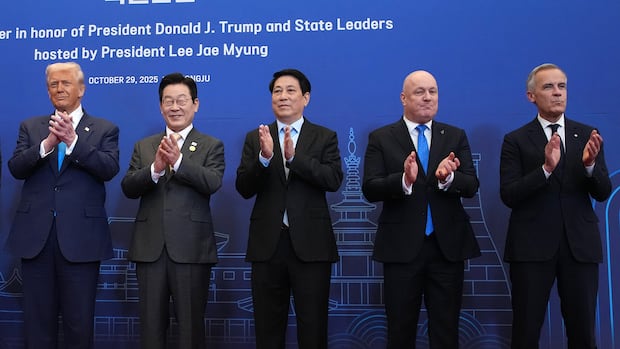
U.S. President Donald Trump expresses no interest in engaging with Prime Minister Mark Carney after he cancelled trade discussions with Canada over an anti-tariff advertisement, despite the two being in close proximity at a dinner prior to the Asia-Pacific Economic Cooperation (APEC) summit.
What About Canada?
Kafura also believes Canada could gain insights from China regarding strategies for managing a trade conflict with Trump.
“The leverage that the Chinese brought to the table was significant,” Kafura noted, specifically highlighting China’s dominance in samarium, a rare earth mineral extensively utilized in military applications.
“Does Canada possess that level of leverage over the U.S.?” he asked rhetorically. “No, but there are still avenues for leverage.”
Kafura explained that such leverage lies in the scale and robustness of the trading relationship between the two nations. The U.S. exports more goods and services to Canada than to any other nation, and imports greater quantities of crude oil, aluminum, potash, and uranium from Canada than from any other country globally.
By at least one measure, Trump’s tariffs have achieved the intended effect. In June, imports from China decreased significantly, leading to a reduction in the U.S. trade deficit with Beijing to a level not observed since 2004.
Nevertheless, it remains uncertain whether the tariffs are inciting the kind of resurgence in U.S. manufacturing that he promised back in April, when he asserted that factory jobs “will come roaring back into our country.”