

As Ontario endures its most severe fire season on record, new findings from McGill University highlight the role of aspen trees as effective fire barriers.
Flavie Pelletier, a doctoral graduate and the primary author of the study, noted that aspen have long been regarded as a species particularly resistant to fire based on anecdotal evidence.
“However, the contradiction is that aspen can ignite rapidly on its own due to its thin bark,” she explained.
Through the examination of satellite images of Canada’s boreal forests before and after fire events, Pelletier and her team discovered that extensive areas of aspen can impede the spread of wildfires.
The comparative images indicated that larger areas of aspen were more commonly found at the edges of charred regions.
Pelletier mentioned a few theories regarding why aspen patches can serve as fire barriers.
“Aspen trees contain significantly more moisture, both in the wood and the leaves, compared to coniferous species,” she stated.
Additionally, the leaves of aspen are positioned higher on the trunk than the needles of coniferous trees such as spruce and pine, making it more likely for ground fires to ignite other species first.
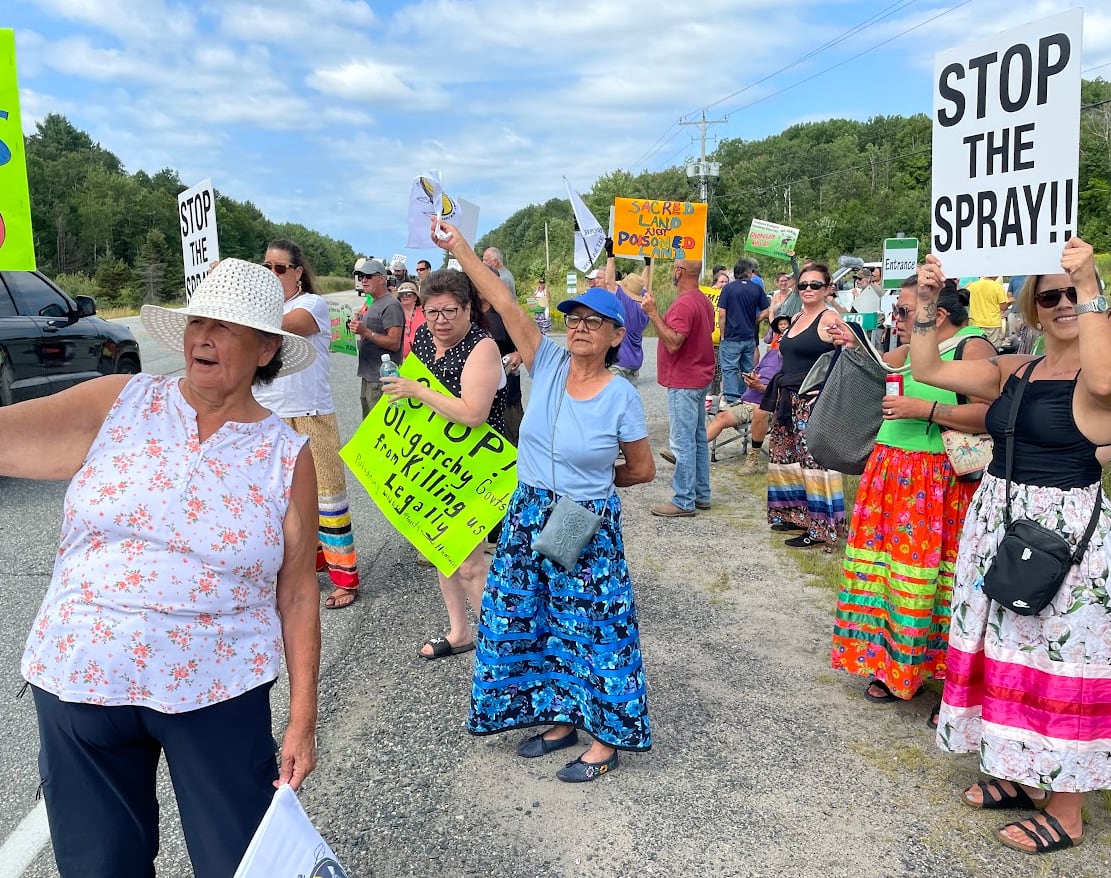
Last summer, members of Serpent River First Nation protested the use of glyphosate by forestry companies in Ontario. (Jonathan Migneault/CBC)
‘Conflict with aspen’
While aspen trees can aid in wildfire containment, Pelletier pointed out that “there is a certain conflict against aspen in commercial forestry.”
Every summer, forestry companies in Ontario treat thousands of hectares of Crown land with herbicides aimed at eliminating broadleaf plants that compete with coniferous trees, which are harvested for their wood.
Glyphosate is the most frequently used herbicide for this purpose.
“By significantly reducing aspen in managed forests, whether through herbicide application or brushing, I truly believe that you are elevating the long-term fire risk,” Pelletier asserted.
Fred Pinto, an adjunct professor of forestry at the University of Toronto and a former executive director of the Ontario Professional Foresters Association, mentioned that some studies indicate that broadleaf trees like aspen can reestablish in areas after being treated with glyphosate.
He noted that the rejuvenation of these broadleaf plants can take between five and ten years.
Pinto stated that only a small portion of Ontario’s boreal forest is harvested annually, and he was unaware of any research indicating whether forests treated with glyphosate are more prone to wildfires.
He added that many of the current wildfires in northern Ontario are occurring in remote areas that have never been logged or treated with glyphosate.
Regarding the toxicity of smoke from wildfires in glyphosate-treated forests, Pinto concluded that the impact would be minimal.
He remarked that the concentration of glyphosate in the forest would be so low relative to the overall biomass that detecting any chemicals in the air would be virtually impossible.
He further noted that wildfires burn at such high temperatures that they would likely vaporize any glyphosate residue present in the atmosphere.