

Following their victory in the team pursuit event at the Beijing 2022 Olympics, speed skaters Ivanie Blondin, Valérie Maltais, and Isabelle Weidemann have become the target for their competitors around the globe.
With the upcoming Winter Games on the horizon, the Canadian trio understands the importance of not becoming complacent as defending champions.
Blondin, Maltais, and Weidemann are currently in Salt Lake City for the initial World Cup competition of the long track season, a shortened event due to the Milano-Cortina 2026 Games in February.
Prior to the rest of the Canadian team’s arrival, the three skaters engaged in a team pursuit-focused camp at the Utah Olympic Oval to refine their strategies and aim for another podium finish.
While they have previously trained together, this camp marks the first time the trio has focused exclusively on the discipline in which they claimed Olympic gold almost four years ago. The evolving competition landscape has necessitated a shift in their race tactics.
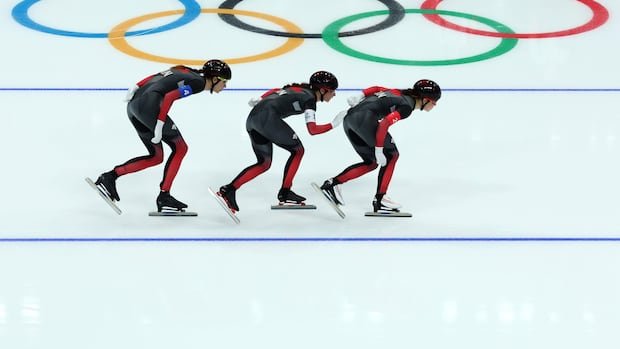
CBC Analyst Kristina Groves breaks down the team pursuit in long track speed skating, which sees three athletes competing together to push each other to the fastest time.
Team pursuit racing involves two teams of three skaters each starting simultaneously on opposite sides of the 400-meter oval and completing six laps. Effective teamwork and strategic positioning are key elements, with the clock only stopping when all team members cross the finish line.
The trio’s initial collaboration at the 2019 world championships resulted in a surprising fourth-place finish, despite limited experience and evolving race strategies that continue to be refined.
Reflecting on that performance, Maltais emphasized the potential of their partnership, indicating a promising future in the sport.
While speed skating is typically an individual pursuit, successful team pursuit requires seamless coordination and strategic planning. With races often decided by fractions of a second, optimizing performance is crucial for achieving victory.