

On Tuesday, former FBI director James Comey faced another indictment, this time related to a social media image featuring seashells arranged on a beach, which authorities claimed posed a threat to U.S. President Donald Trump.
This latest criminal case marks the second such action against Comey within a few months and is indicative of the Trump administration’s Justice Department’s ongoing efforts to pursue political adversaries of the Republican president.
The photograph of the seashells was shared nearly a year ago, but the indictment was obtained as acting U.S. Attorney General Todd Blanche, a Trump ally who previously served as his personal lawyer, seeks to demonstrate his suitability for the permanent role.
The indictment includes two charges against Comey: “knowingly and willfully” threatening to “take the life of, and to inflict bodily harm upon” Trump, as well as transmitting a threat across state lines.
Despite the allegations, the indictment does not provide any evidence indicating that Comey intentionally threatened the president, especially as he has publicly denied such claims. However, it suggests that a “reasonable recipient who is familiar with the circumstances would interpret” the message as a potential threat.
During a news conference to announce the indictment, Blanche refrained from discussing any specific evidence of intent but remarked: “How do you prove intent in any case? You prove intent with witnesses, with documents, and with the defendant himself to the extent it’s appropriate. And that’s how we’ll prove intent in this case.”
In an attempt to counter assertions of selective prosecution, Blanche argued that the case against Comey resembles other threat-related cases that the department regularly pursues involving lesser-known individuals.
“While this case is unique and this indictment stands out because of the name of the defendant, his alleged conduct is the same kind of conduct that we will never tolerate and that we will always investigate and regularly prosecute,” Blanche stated.
‘I’m still innocent,’ Comey says
The indictment was filed in North Carolina’s Eastern District, where Comey discovered the seashells.
In a video message posted to his Substack page, Comey reacted to the indictment by saying, “Well, they’re back,” while asserting that nothing has changed.
“I’m still innocent. I’m still not afraid, and I still believe in the independent federal judiciary,” he declared. “So let’s go.”
He emphasized that “this is not the way the Department of Justice is supposed to be” and encouraged the public to “keep the faith.”
During his tenure, Comey oversaw the initial phases of an investigation into whether Trump’s 2016 campaign had colluded with Russia to influence the election results.
Comey was dismissed by Trump a few months into the president’s first term, leading to a public feud between the two.
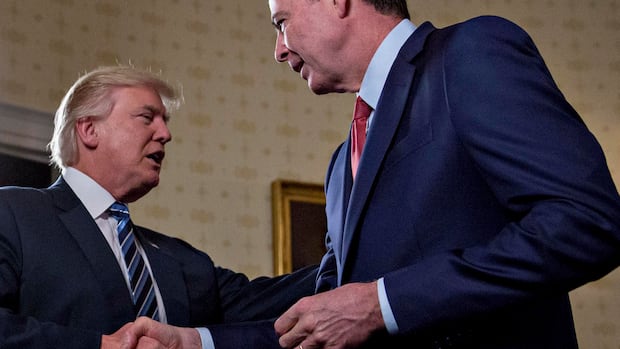
In an apparent escalation of U.S. President Donald Trump’s attacks on his political enemies, former FBI director James Comey has now been indicted on criminal charges. For The National, CBC’s Lyndsay Duncombe lays out a timeline of how it got to this point.
The indictment relates to a post made in May on Instagram, where Comey shared a photograph of seashells he encountered on a walk arranged in the sequence of “86 47.”
He has stated he assumed the numbers conveyed a political message and not a call for violence. Comey promptly deleted the post, explaining: “I didn’t realize some folks associate those numbers with violence” and “I oppose violence of any kind so I took the post down.”
Nevertheless, Comey was quickly interviewed by the Secret Service following assertions from Trump administration officials that he was suggesting the assassination of Trump, the 47th president.
The alleged meaning
Merriam-Webster, the dictionary referenced by the AP, defines 86 as slang for “to throw out,” “to get rid of,” or “to refuse service to.” It also notes: “Among the most recent senses adopted is a logical extension of the previous ones, with the meaning of ‘to kill.’ We do not enter this sense, due to its relative recency and sparseness of use.”
In a Fox News Channel interview in May, Trump accused Comey of being aware of “exactly what that meant.”
“A child knows what that meant,” Trump declared. “If you’re the FBI director and you don’t know what that meant, that meant assassination. And it says it loud and clear.”
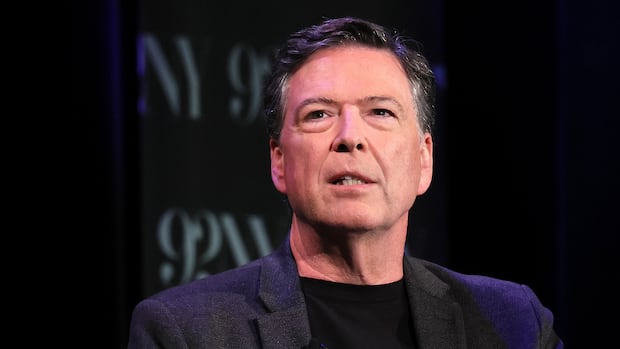
A day after the indictment of former FBI director James Comey, U.S. President Donald Trump suggested his other perceived foes could be next. Democrats were quick to sound the alarm in response, calling it a ‘dark day for America.’
Comey faced an indictment in September on charges that he misled and obstructed Congress regarding his 2020 testimony about whether he authorized sharing insider information about an investigation with a journalist.
He denied any wrongdoing, and the case was later dismissed after a judge concluded that the prosecutor who filed the indictment was improperly appointed.
Comey was serving as FBI director when Trump assumed office in 2017, having been appointed by then-President Barack Obama, a Democrat. Prior to this, he held a senior role in the Justice Department during George W. Bush’s Republican administration.
However, the relationship with Trump was tense from the outset, particularly after Comey declined a request from Trump during a private dinner to pledge his personal loyalty to the president—a request that deeply unsettled the FBI director, leading him to document it in a contemporaneous memo.
Trump dismissed Comey in May 2017 while the FBI was investigating potential connections between Russia and Trump’s presidential campaign. That investigation, later taken over by special counsel Robert Mueller, ultimately determined that while Russia did interfere in the 2016 election and the Trump campaign welcomed this assistance, there was insufficient evidence to demonstrate a criminal conspiracy.
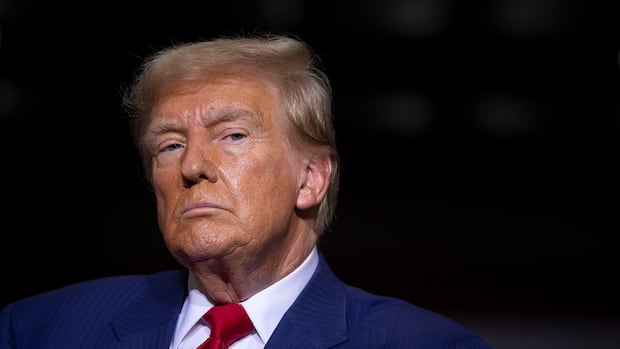
U.S. President Donald Trump’s revenge campaign against his political enemies has some worried about the integrity of the justice system as he blows past checks and balances that contained similar attempts by former president Richard Nixon.
Politically charged prosecutions
Blanche was promoted from deputy attorney general to acting attorney general earlier this month, taking over from Pam Bondi, who had frustrated Trump due to the department’s difficulties in building solid criminal cases against his opponents.
Since then, Blanche has swiftly initiated politically sensitive prosecutions, including one last week against the nonprofit Southern Poverty Law Center, which the Justice Department alleges defrauded donors by compensating confidential informants to infiltrate hate groups. The organization denies any wrongdoing.
Comey is among numerous Trump adversaries facing scrutiny over the past year.
Additionally, the Justice Department is pursuing a criminal inquiry into former CIA director John Brennan, another pivotal figure in the Russia investigation—a primary grievance for Trump, who and his supporters have long sought retaliation. Brennan has denied any misconduct.
CNN was the first outlet to report on the second indictment against Comey.