

As a housewife in 1982, what weighs on your mind the most? Is it your children flirting with their teenage peers or perhaps fleeing from the neighborhood bully? Or is it that your husband, who has been somewhat distant, refuses to handle the barbecue because he’s off working the second job you suggested he leave behind?
Or maybe your greatest concerns stem from the flickering blue lights around town, the stifling heat enveloping the atmosphere, or the sight of what appears to be a dinosaur’s tail winding through your yard.
Welcome to Oak Street — or as our protagonist Denise (played by Anne Hathaway) and writer/director David Robert Mitchell ominously refer to it, The End of Oak Street. Here, a mild-mannered yet profoundly unhappy family’s neighborhood is mysteriously transported back to the late Jurassic era, where they must contend with bizarre creatures lurking outside their home while also grappling with their own internal divisions.
This Spielbergian narrative, which also feels like it could have been inspired by Stephen King, effectively captures the intended atmosphere.
From the detached yet caring, functional-alcoholic father Greg (Ewan McGregor) to the wistful genius older sister Audrey (Maisy Stella) and the innocent little brother Brian (Christian Convery), this Detroit family embodies a quintessentially middle-American essence reminiscent of a Leave it to Beaver Independence Day special.
If we take the consensus of film critics into account, it appears to be the ideal formula for an Amblin-style, B-movie homage. Even though some may find it somewhat simplistic, the straightforward sentimentality of Oak Street resonates as the nostalgic 80s adventure that audiences are craving amidst the barrage of self-serious, trauma-heavy films.
If you’re in search of a fun cinematic experience, what could possibly go wrong with a direct, time-traveling dinosaur movie?
As it turns out, quite a bit actually.
While Oak Street can be genuinely entertaining and somewhat innovative, it feels like something is lacking in what has been widely hailed as the blockbuster of the summer we’ve all been anticipating.
Rather, it feels like a film that is merely going through the motions, clearly aware of the aesthetics of classic Spielberg films but lacking an understanding of the artistic intentions that underpin them.
This is precisely the kind of movie you would expect to find at the center of a controversy regarding an AI-generated version of the family dog being used to promote the film on a fake podcast.
An interpretation of Jurassic Park that starts and ends with views through the legs of a brachiosaurus — yet lacks any commentary on human arrogance or critiques of capitalism.
There’s a fascination with the kids-on-bikes-solving-mysteries vibe of E.T. — but it fails to acknowledge the underlying themes of anti-xenophobia and governmental paranoia.
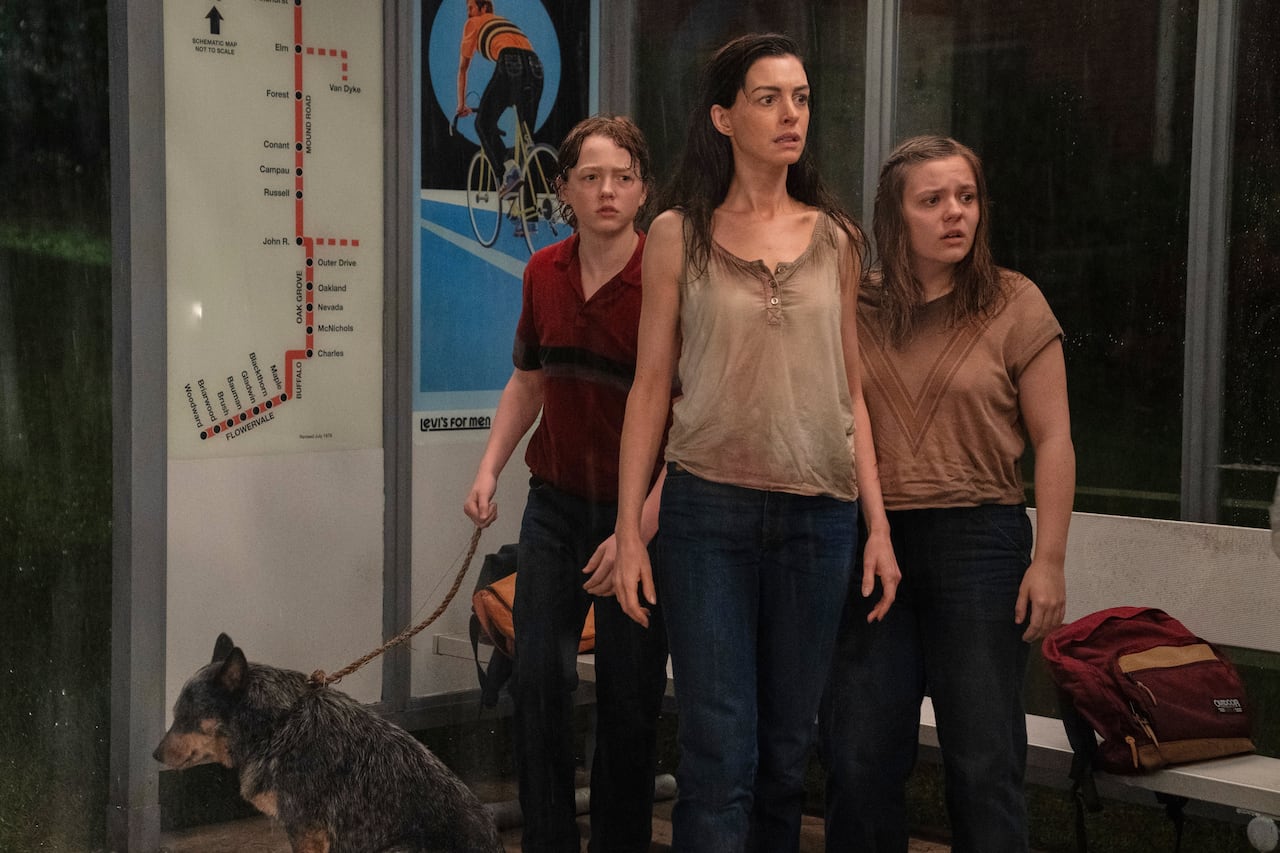
From left, Christian Convery, Anne Hathaway, and Maisy Stella in a scene from The End of Oak Street. (Warner Bros. Pictures/The Associated Press)
In The End of Oak Street, this realization hits you rather swiftly.
In a nearly remarkable display, the stakes for each character are juggled and dismissed faster than pterodactyls tearing flesh from a hefty man’s chest — a scene that indeed occurs in Oak Street.
Will the film delve into the theme of unrealized potential — introduced through Denise’s covert aspirations to start a writing career with the aid of a nearby elderly editor? Will it explore the pursuit of survival in the face of daunting threats, as illustrated by Audrey’s hinted crush on the girl next door?
Will it examine the moral integrity of individuals when confronted with dire situations — perhaps through Brian’s almost obsessive focus on his dog’s safety and the casual cruelty he exhibits towards neighborhood friends?
The response in The End of Oak Street is somewhat affirmative — but ultimately, no. Despite each family member harboring secrets, any character development is thrown aside the moment a dinosaur begins to huff and puff.
Given the film’s relatively short runtime (one hour and 39 minutes) and the elongated introductions for each family member, little time remains to explore anything other than showcasing these underdeveloped characters screaming at increasingly dubious-looking therapods and sauropods behaving in increasingly questionable ways. You might never have imagined witnessing dinosaurs in such intimate scenarios before.
-
REVIEW
Moana live-action remake is just more slop from the trough
-
REVIEW
Supergirl is almost impressively boring. Almost.
However, the dinosaur encounters grow increasingly tedious due to a lack of character development, repetitive action scenes, and imitative visual styles. After the fourth or fifth instance of Brian fleeing from yet another similarly dangerous growling creature, you might begin to question the purpose of it all.
And during a family discussion where every member receives the Jaws split-diopter treatment without any narrative justification, it feels more like a tribute band to Spielberg than the emergence of a fresh talent.
This leads to an important consideration: does it truly matter that this dinosaur disaster film lacks a deeper meaning? Perhaps not — after all, we’re here for the spectacle, and for that, giant reptiles with enormous teeth demolishing flaming vehicles suffice.
Yet some may argue that it does matter, as this concept has been explored before, and executed more effectively.
Kazuo Umezu’s The Drifting Classroom portrayed a school inexplicably cast into a dystopian future — quite clearly influenced by Japan’s post-atomic bomb anxieties. Similarly, 1983’s Testament navigated similar themes of isolated suburban terror to convey a narrative of a family enduring nuclear fallout in a setting eerily akin to the first half of Oak Street.
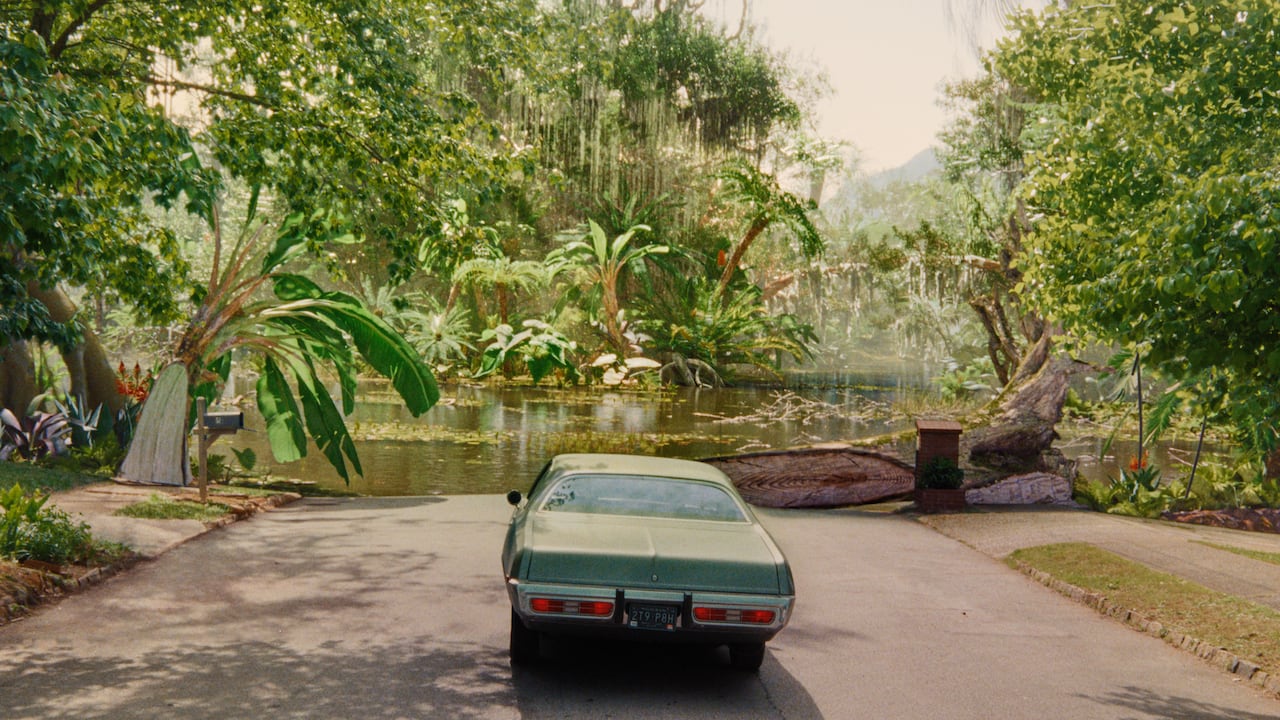
The End of Oak Street tells the story of a suburban neighbourhood that’s mysteriously transported back in time to the late Jurassic period. (Warner Bros. Pictures/The Associated Press)
Yet, despite the absence of in-depth analysis, there remains a sense that something is lacking.
Because even with Oak Street‘s generally engaging sequences, viewers may find themselves glancing at their watches, as the director hasn’t provided any substantial reason to support the protagonists.
Or perhaps they won’t mind.
Maybe the mere fact that Oak Street resembles Spielberg’s films in look and sound will suffice — even if it appears that the creators lacked concern for the messages those films conveyed.
And if that’s the case, it bodes well for the future of AI-generated movies.