

U.S. President Donald Trump has removed a federal prohibition on mining activities close to Minnesota’s Boundary Waters Canoe Area Wilderness, allowing a South American firm interested in the area’s valuable minerals to start the application process for permits.
Environmental advocates are concerned that this decision may set a dangerous precedent for dismantling additional protections for public lands throughout the nation. Twin Metals Minnesota LLC, a subsidiary of Antofagasta Minerals based in Chile, has been pursuing opportunities to extract copper, nickel, and other valuable metals in Superior National Forest since 2019.
The canoe area is located downstream from the proposed mining site within the national forest, leading to worries that mining operations could lead to pollution that threatens one of the few remaining pristine wilderness areas in the country.
The previous administration of Joe Biden established a 20-year ban on mining in the national forest in 2023, putting a halt to Twin Metals’ ambitions.
However, Trump has advocated for enhancing domestic production of energy and minerals, and earlier this month, congressional Republicans presented him with a resolution aimed at lifting the moratorium, claiming it would generate jobs and revitalize the mining sector in Minnesota’s Iron Range. The president endorsed the resolution on Monday.
“Today marks a troubling day for America’s cherished wilderness, the Boundary Waters Canoe Area Wilderness, and serves as a stark warning for public lands nationwide,” stated Ingrid Lyons, executive director of Save the Boundary Waters, in a press release.
“Minnesotans and the broader American public have made their stance clear — this iconic region requires protection. Today, they were overlooked by those who profess to represent them, and even worse, silenced. Nevertheless, this fight is far from over, and we will continue our efforts.”
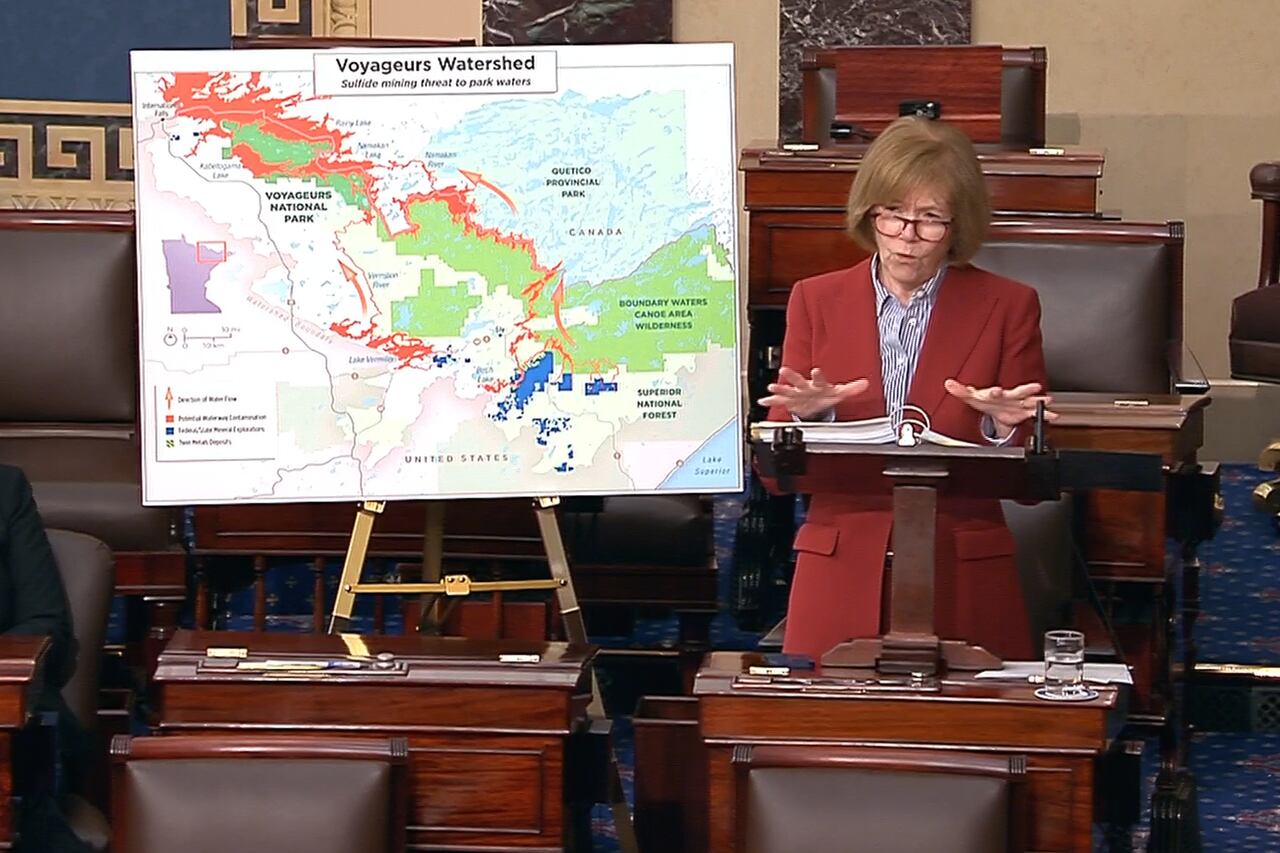
United States Sen. Tina Smith, a Minnesota Democrat, speaks about the Boundary Waters in northern Minnesota on the Senate floor in Washington, D.C., on April 15. (Senate Television via The Associated Press)
Kathy Graul, a spokesperson for Twin Metals, indicated in a statement to The Associated Press that the lifting of the moratorium opens a chance to enhance mineral supply chains, while emphasizing that the company must still navigate a thorough permitting process that may take several years.
The mining site comprises a mix of state, federal, and private lands, creating a complex regulatory environment.
The initial challenge for the company involves re-establishing its right to mine, as officials from Biden’s Department of the Interior canceled its federal site leases in early 2022.
-
Worries grow over boundary water pollution in Minnesota and Ontario, as Biden-era mining ban nears reversal
-
Trump expected to OK resolution to lift mining ban on Minnesota wilderness area near Canadian border
Twin Metals has initiated a federal lawsuit to affirm the validity of its leases, but a judge dismissed the case in 2023. The company is currently appealing that ruling.
Additionally, Twin Metals must obtain a mining permit from the Minnesota Department of Natural Resources by demonstrating its ability to prevent water pollution, manage waste rock safely, and rehabilitate the land post-mining. The company will also require state permits for water and air.
U.S. Senator Amy Klobuchar, a Democrat from Minnesota who voted against lifting the moratorium, could pose a significant obstacle for the company if she secures the governorship in the upcoming November elections.
Environmental organizations and Indigenous tribes could potentially contest every permit in court, which may delay Twin Metals’ initiatives for several years. Friends of the Boundary Waters, for instance, has stated that they are actively considering litigation.
Moreover, Canadian authorities might express concerns regarding the potential for the mine to cause cross-border pollution, which could breach treaties with the United States.
The Boundary Waters serves as a natural divide between northeastern Minnesota and northwestern Ontario, hence its name. Quetico Provincial Park, another wilderness area famous for its backcountry paddling routes, is located just across the border.
This region remains primarily untouched by human activity. Logging is banned, aircraft must adhere to minimum altitude regulations when flying above it, and motorized boats are restricted to designated areas.
The U.S. Forest Service issued approximately 776,000 visitor permits from 2020 to 2024.