

President Donald Trump is significantly reducing the number of refugees permitted to enter the United States, placing individuals escaping from conflict zones, human rights violations, and disasters at a lower priority compared to white individuals from South Africa.
The Trump administration has proposed a limit of just 7,500 refugee admissions for the 2026 fiscal year, which commenced on October 1, a drastic cut from last year’s cap of 125,000 set by the Biden administration.
While the White House did not elaborate on the reasons behind the steep reduction announced in a Federal Register notice, this new limit marks the lowest level of refugee admissions since the program began in 1980.
This notice was issued on September 30 but was officially enacted on Thursday.
The notice indicates that admissions will “primarily be allocated” to the Afrikaner white minority group from South Africa, which Trump and some of his supporters claim face “race-based” discrimination and violence in their country — even asserting, without credible evidence, that they are endangered by “genocide.”
However, Afghans escaping persecution from the Taliban, including women subjected to gender-based violence under the regime, individuals fleeing the conflict in Sudan, and those escaping gang violence in countries like Haiti are not prioritized under this new policy, which favors only Afrikaners.
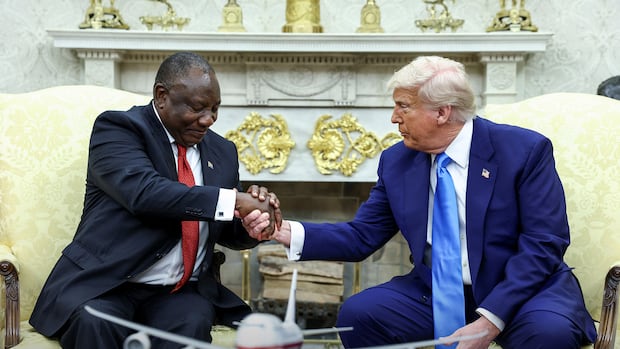
U.S. President Donald Trump confronted South African President Cyril Ramaphosa in the Oval Office on Wednesday, presenting videos and images that he claimed demonstrated genocide against white farmers in South Africa. Ramaphosa rejected the allegations during a tense exchange.
Sharif Aly, president of the International Refugee Assistance Project (IRAP), criticized the U.S. government for “politicizing a humanitarian program” and granting preferential treatment to Afrikaners.
“It is outrageous to disregard refugees who have undergone extensive security screenings and are presently trapped in perilous and unstable circumstances,” Aly stated in a statement.
Trump’s policy responds to unfounded claims
Aly noted that this recent directive illustrates “how far this administration has strayed in neglecting its obligations to displaced individuals globally.”
IRAP is currently suing the Trump administration following an executive order signed on his first day in office earlier this year, which indefinitely halted the U.S. Refugee Admissions Program until it “aligns with the interests” of the nation.
Yet, months later, Trump began to facilitate the entry of white South Africans, announcing a new initiative earlier this year to expedite the relocation of Afrikaner farmers who claim, without substantiated evidence, that they are facing systematic violence.
The South African government has firmly denied these claims.
Around 70 white South Africans were relocated to the U.S. in two separate groups in May and June, marking the initial phase of the program, according to U.S. officials.
Reports indicate that approximately 400 white South Africans have already been resettled in the U.S.
The Washington Post noted, citing anonymous sources, that the U.S. State Department “aims to process 2,000 Afrikaners for resettlement by the end of October and an additional 4,000 by the end of November.”
There are roughly 2.7 million Afrikaners within South Africa’s population of 62 million, which is predominantly Black, exceeding 80 percent.
Afrikaners, who played a central role in the apartheid regime that lasted from 1948 until 1994, remain active across all sectors of South African society today, including being prominent business figures, celebrated athletes, and government officials.

Diminishing ‘our moral standing’
In contrast, the leading countries of origin for over 100,000 refugees admitted into the U.S. in 2024 included the Democratic Republic of the Congo, Afghanistan, and Syria — nations that have faced years of severe violence.
Focusing on a single group “undermines the purpose and credibility of the [refugee] program,” explained Krish O’Mara Vignarajah, president and CEO of Global Refuge, a U.S.-based resettlement organization.
“This decision not only reduces the refugee admissions ceiling, but also diminishes our moral standing,” she remarked in a statement on the organization’s website.
The advocacy group Human Rights First labeled the policy as “outrageously racist.”
“Turning our back on countless truly at-risk refugees fleeing religious, political, and other forms of persecution contradicts decades of bipartisan support for assisting the vulnerable, from Vietnamese to Afghan allies,” stated Uzra Zeya, the organization’s president and a former U.S. State Department official, in a statement.
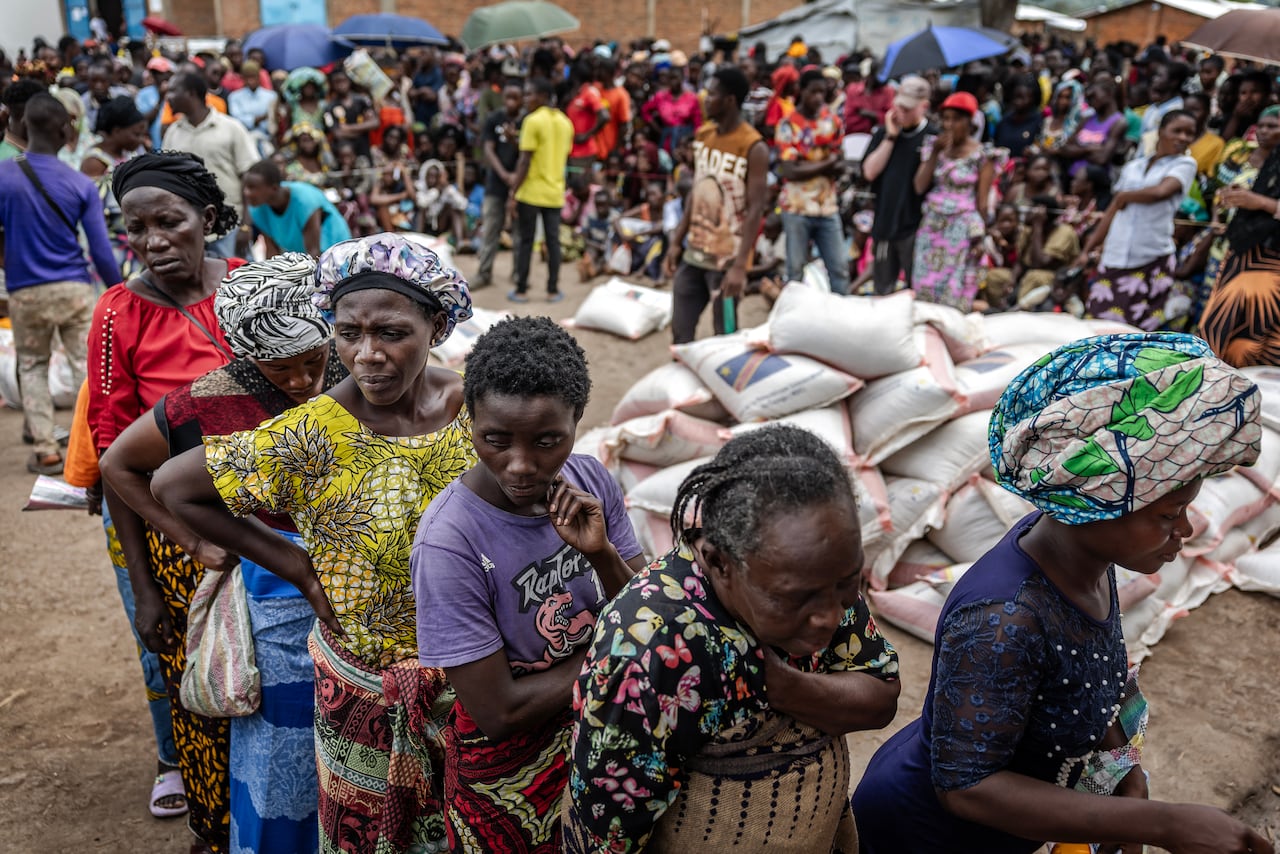
Congolese refugees line up to receive aid during a food distribution operation at the Musenyi refugee site in Giharo, Burundi, on May 7. More than 71,000 people fled to Burundi between January and May amid ongoing violence in the eastern part of the Democratic Republic of Congo. (Luis Tato/AFP/Getty Images)
Guerline Jozef, director of immigration for Haitian Bridge Alliance, described the new limit as “white supremacy under the guise of refugee policy.”
“At a moment when Black refugees from Haiti, Sudan, the Congo, and Cameroon are facing perilous situations, the U.S. government has opted to extend its welcome to those who are already privileged,” she stated, as reported by The Independent.
Shawn VanDiver, president of #AfghanEvac, an organization advocating for the resettlement of at-risk Afghans, characterized the decision as a “terrible betrayal.”
“We need to face reality. This indicates that the president and the White House … are not going to permit Afghan refugees to enter,” he expressed in a video shared on Instagram. “This is a truly unfortunate day.”