

President Trump and Secretary of Defense Pete Hegseth have presented various, sometimes conflicting, estimations regarding the duration of the military campaign against Iran. While maintaining secrecy about the war’s end date for strategic reasons, both officials have offered timelines for the combat mission, which have been inconsistent.
Since the commencement of airstrikes on February 28, Trump and Hegseth have made statements about the expected duration of the conflict:
- Day 1: Trump shared on Truth Social that the bombings would continue “throughout the week or as long as necessary” to achieve peace in the Middle East and globally.
- Day 2: Trump stated in a video update that the war would persist “until all of our objectives are achieved.”
- Day 3: Trump mentioned during a military ceremony a projected timeline of four to five weeks but acknowledged the capability to extend the operation further.
- Day 5: Hegseth informed Pentagon reporters that while initially suggesting four weeks, the duration could be extended to six, eight, or three weeks, depending on the pace set by the U.S.
- Day 7: Trump declared on social media that there would be no agreement with Iran except for unconditional surrender.
- Day 9: Hegseth expressed the willingness to prolong the campaign as necessary for success during an interview with CBS’s 60 Minutes.
- Day 10: Responding to a reporter, Trump indicated that the war would not conclude that week but hinted at an imminent end.
On the 11th day of the U.S.-Israel joint military operation against Iran, Hegseth and White House press secretary Karoline Leavitt attempted to address the conflicting statements.
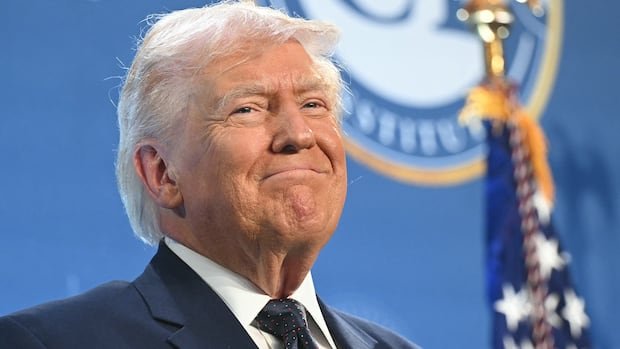
President Trump’s statements on the Iran war have been contradictory, emphasizing completion of objectives while hinting at ongoing conflict.
Both Hegseth and Leavitt emphasized that Trump will determine the war’s conclusion based on the objectives set for the campaign.
“The president holds the authority to define the end state of these objectives,” Hegseth stated at a Pentagon news conference.
Trump’s Control Over the War
Hegseth highlighted that Trump has the authority to decide when the objectives are met and when the operation concludes, indicating that it is not his role to speculate on the timeline.
Leavitt echoed a similar sentiment during a White House press briefing later, emphasizing that the operations would cease when the president deems the military goals achieved, with Iran in a state of complete surrender, regardless of explicit confirmation.
Despite these statements, there is no indication of Iran surrendering imminently. The appointment of Ayatollah Mojtaba Khamenei as Iran’s supreme leader suggests a firm stance by Tehran, according to analysts.
A defiant post by Iran’s parliament speaker, Mohammad Bagher Ghalibaf, underlined their reluctance for a ceasefire, emphasizing the need to punish aggressors.