

On Thursday, Hamas delivered two bodies it claimed belonged to deceased Israeli hostages, just one day after a fragile ceasefire in Gaza was disrupted by a series of Israeli airstrikes that resulted in the deaths of many Palestinians, including numerous women and children, in the war-torn region.
The office of Israeli Prime Minister Benjamin Netanyahu confirmed that the two bodies were received by Israeli forces through the Red Cross in Gaza and will be transported to Israel for identification purposes.
As part of the ceasefire agreement, Hamas released the remaining 20 living hostages it had taken in Gaza in exchange for the release of almost 250 Palestinians who had been convicted or suspected of security offenses, along with 1,700 adults and 22 minors detained during the conflict without charges.
Additionally, Hamas consented to surrender the remains of all 28 deceased hostages in return for 360 militants killed by Israeli forces throughout the conflict. Up until Thursday, Hamas had returned 15 bodies.
Israel has expressed concerns that Hamas is delaying the return of the remaining bodies, while Hamas has stated that it needs time to locate and retrieve all the remains.
Families of the hostages are anxious to ensure a dignified burial for their loved ones and are worried that their remains may be lost forever amidst the devastation in Gaza.
Amid the extensive destruction, thousands of Palestinians who are believed to have perished remain unaccounted for.

The CBC’s Crystal Goomansingh crossed into northern Gaza as part of an embed with the Israel Defence Forces. Here’s what she saw from the outskirts of Gaza City, behind the yellow line — the boundary to which Israeli forces agreed to retreat under the ceasefire plan with Hamas.
The ongoing dispute regarding the retrieval and transfer of bodies has emerged as a significant hurdle in U.S. President Donald Trump’s initiative to conclusively resolve the Gaza conflict.
Several significant challenges remain, including the future governance of Gaza and the insistence on Hamas disarming. Simultaneously, both parties have been exchanging accusations regarding violations of the ceasefire.
Witnesses reported that Israeli aircraft executed 10 airstrikes in regions east of Khan Younis in southern Gaza, while tanks shelled areas east of Gaza City shortly before dawn on Thursday.
No casualties were reported from these attacks.
The Israeli military stated that it conducted “precise” strikes against “terrorist infrastructure that posed a threat to the troops” in the sectors of Gaza where its forces remain stationed.
From Tuesday into Wednesday, Israel retaliated with strikes on Gaza following an attack on its troops that resulted in the death of one soldier.
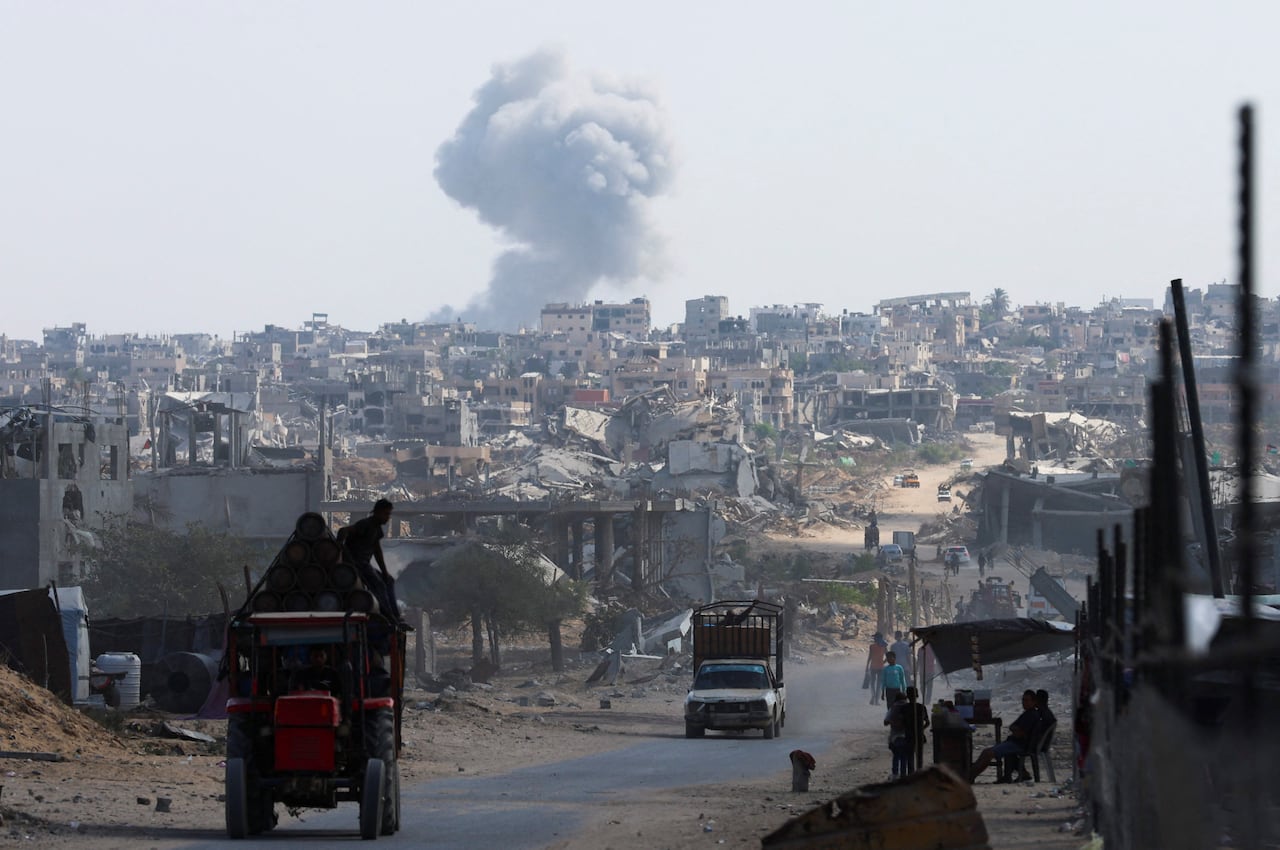
Smoke rises above the city of Khan Younis in southern Gaza after an Israeli airstrike on Thursday. (Ramadan Abed/Reuters)
According to the Gaza Health Ministry, among the 104 individuals killed in the airstrikes were 46 children and 20 women. Israel contends that its strikes targeted numerous militants.
Residents of Gaza express concerns about the possibility of renewed conflict.
“We are afraid that another war will break out, as we do not want war. We have endured two years of displacement. We are uncertain where to go or where to return,” stated Fathi Al-Najjar, a displaced individual in Khan Younis, southern Gaza.
At the encampment where Najjar spoke, children were filling plastic bottles with water from metal containers placed along the street, while women prepared food for their families using clay ovens fueled by wood.
The conflict has displaced most of Gaza’s population of over two million, with many individuals having been displaced multiple times. A significant number have not yet returned to their homes, fearing further displacement could occur.
Israeli planes launched strikes on Gaza City after Prime Minister Benjamin Netanyahu accused the militant group Hamas of violating a ceasefire in the Palestinian territory.