

Recent studies of jade artifacts discovered east of the Rocky Mountains provide insights into extensive Indigenous trade routes that existed in pre-colonial Western Canada.
For over 3,000 years, nephrite jade was meticulously hand-polished and shaped into functional items such as blades, chisels, and axe heads.
For the central and coastal Salish communities in the Pacific Northwest, these durable tools — crafted from a tough stone available in various hues like emerald green, black, yellow, and white — were vital for carving the wood that was fundamental to their daily existence.
Interestingly, some of these stone implements traveled from their quarry sites in British Columbia across the Rocky Mountains and have been found in Alberta, Saskatchewan, and Manitoba.
The Archaeological Survey of Alberta, based in Edmonton, conducted a peer-reviewed research on these tools, which was recently featured in North American Archaeologist. This study brought together scholars from the University of Alberta, University of British Columbia, University of Saskatchewan, and the Royal Saskatchewan Museum.
Their research indicates that these items, referred to as stone celts, were highly sought-after prestige objects within the Prairies.
Originating in what is now British Columbia, these tools were transferred to Dene and Cree communities located east of the Rockies through extensive trade networks that existed before contact, transcending cultural and linguistic divides.
The broad distribution of such artifacts illustrates that significant social networks existed among Indigenous peoples across Western Canada, stated Todd Kristensen, the regional archaeologist at the Archaeological Survey of Alberta and lead author of the study.
“By the time they crossed the Rockies approximately 1,000 years ago, the jade had transformed into a symbol of social alliances and connections — more of a gift than a practical tool,” he explained.
‘The mystery’
The research aimed to resolve longstanding questions within anthropology. While the use of nephrite by pre-contact peoples in British Columbia is well-established, its occurrence east of the Rockies had not been thoroughly examined, Kristensen noted.
Given the absence of local nephrite sources or evidence of local production in the Prairies, scholars were curious about the origins of these artifacts and the pathways they took to arrive there.
“In British Columbia, these tools were utilized to construct cedar dugout canoes and various woodworking projects,” Kristensen remarked. “In Alberta and Saskatchewan, where a few of these jade celts have been discovered, the context is quite different.
“That was part of the enigma. Why are these jade artifacts found in areas where they don’t seem to have served a practical purpose?”
Researchers examined the 24 nephrite celts documented east of the Rockies over the last 75 years. They confirmed the mineral content and origin through methods such as portable X-ray fluorescence, gamma spectrometry, and specific gravity tests.
The analysis confirmed that all specimens originated from the Fraser River area of British Columbia.
The study revealed that, on average, the celts journeyed nearly 850 kilometers from their source, with some traveling almost 1,500 kilometers.
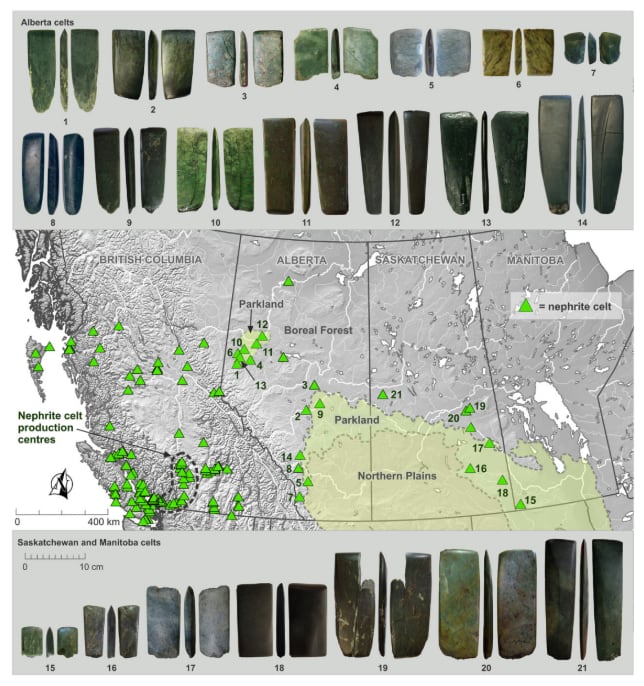
This graphic from the Archaeological Survey of Alberta details all known locations where jade stone celts have been found east of the Rocky Mountains. (Archaeological Survey of Alberta)
The research suggests multiple potential routes for how these items traversed the continent.
It is proposed that craftspeople from the Interior Salish traded with neighboring Dene groups, who subsequently transported the celts eastward across the Rockies to share with Dene relatives and ancestral Cree communities.
Additionally, it is suggested that Dene groups moving west from northern Alberta for trade fairs on the Fraser River may have acquired the celts and brought them back, or that Salish groups could have traveled east into Alberta’s mountain river valleys to trade directly with western Dene communities.
“We believe that the movement of Dene people through this region fostered new relationships that facilitated the eastward journey of jade across the Rocky Mountains,” Kristensen added.
“Jade might serve as a key indicator of a new economic relationship that changed how goods were distributed.”
‘Beautiful object’
The creation of a single nephrite celt involved a labor-intensive process of grinding and polishing. A smaller celt could require upwards of 100 hours to produce, while larger specimens might take as long as 500 hours.
“Investing 100 hours into an item imbues it with significant meaning and value,” Kristensen stated.
Celts in the Pacific Northwest were often re-sharpened and used as tools for generations. However, those found by archaeologists in parklands and boreal forests, where communities depended on birch bark and hide structures instead of heavy timber, were noticeably larger and exhibited minimal signs of wear.
This indicates that the stone celts had likely ceased to function as tools as they traveled further away; instead, they became symbols of status.
Kristensen likens them to cherished items that someone might display on a desk or mantelpiece today.
“It’s a stunning object, but its true worth lies in the relationships that brought it here,” he remarked.
Traditionally, pre-contact peoples are depicted as isolated hunter-gatherers, but this study offers a different perspective, Kristensen noted.
“We often think of societies as merely surviving by gathering enough tools, food, and resources. However, relationships were equally vital,” he explained.
“This jade research is helping us to better understand that reality.”
Kisha Supernant, director of the Institute of Prairie and Indigenous Archaeology at the University of Alberta, stated that this research challenges the notion of isolated pre-contact Indigenous groups, instead highlighting human connections and extensive travel across the western landscape.
Supernant commended the researchers for engaging with Indigenous communities and linking their findings to the broader narrative of pre-contact Indigenous cultures.
“This integration of the human element is crucial, as archaeology fundamentally seeks to comprehend the lives of past peoples,” she remarked.
Kristensen highlighted that the research significantly depended on citizen science, as nearly all 24 artifacts were initially discovered by farmers tilling their fields, rather than through formal archaeological digs.
Looking ahead, he mentioned that the research team intends to collaborate with Indigenous communities to align their findings with traditional oral histories.