

In the previous year, sales representative Ryan Crumly forecasted that farmers would eagerly embrace drone technology once regulations permitted their use for spraying insecticides and fungicides on agriculture.
It seems he was correct.
At the close of June, Health Canada removed its limitations, allowing drones to apply approved pesticides. Crumly, who is associated with Titan Aero Drones, remarked that this shift “opened the floodgates” for farmers interested in the technology.
“My phone has never been so busy,” he shared.
“We had nearly 80 drones, and they were sold out within days.”
Both farmers and drone retailers are pleased with this regulatory update, asserting that drones can outperform traditional ground sprayers and aircraft. The anticipated adoption of pesticide-spraying drones is expected to be substantial, as many farmers express intentions to purchase them in the coming years.
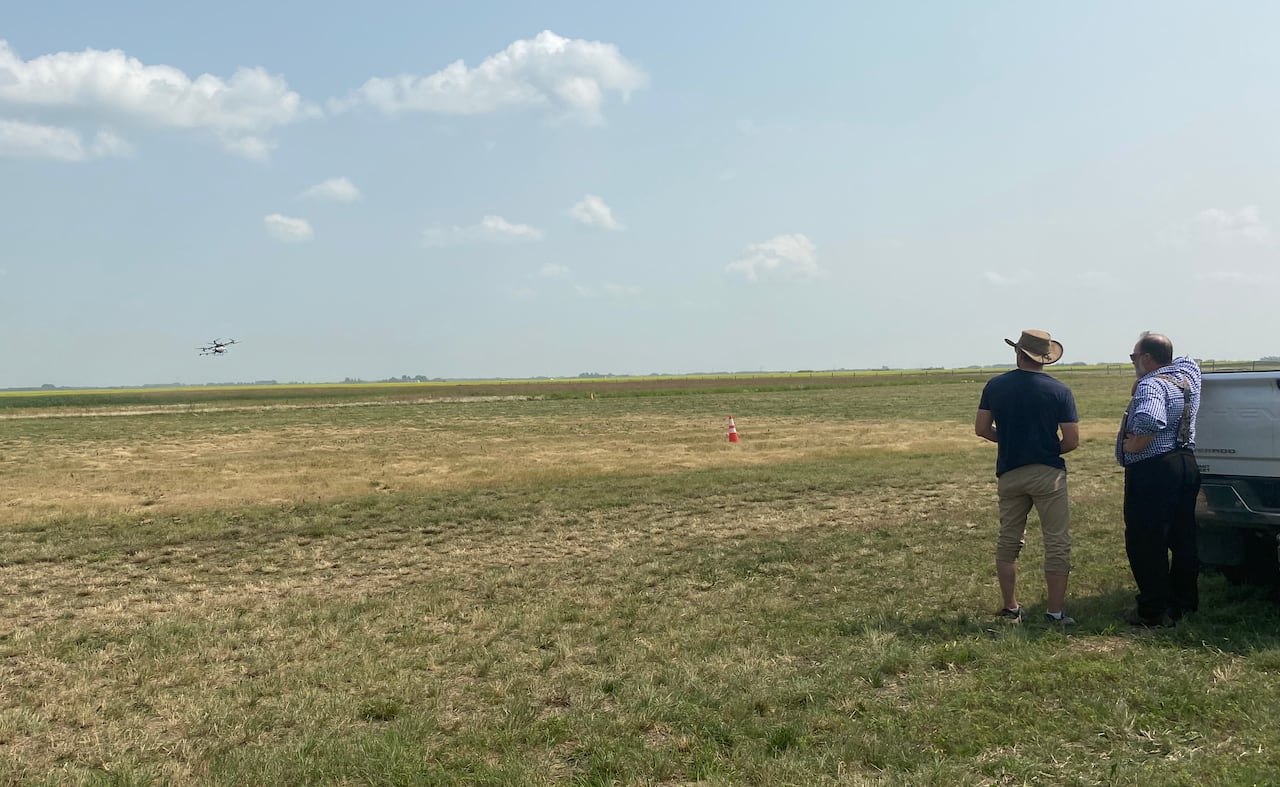
Two attendees of the Ag In Motion convention observe a spray drone demonstration on July 22, 2026, in Langham, Sask. (Maia Tustonic/CBC)
‘You’re just a babysitter’
Drones designed for pesticide spraying are celebrated as an innovative technology offering numerous advantages.
According to Crumly, they have an edge over planes and helicopters, which can only operate during daylight and struggle to navigate near trees or powerlines.
This year, he also received feedback from farmers particularly interested in drones because flooding had rendered their ground sprayers immobilized in mud.

Artificial intelligence is making strides across numerous sectors, and agriculture is no exception. The Ag in Motion event will showcase many cutting-edge advancements. This expo is the largest of its kind in Western Canada, located just 15 minutes northwest of Saskatoon in Langham. Professor Steve Shirtliffe shared insights with Saskatoon Morning host Candice Lipski.
Crumly added that they are user-friendly. Farmers can plan out the areas and methods for the drone to spray, and the device largely operates on its own.
“You’re just a babysitter who changes batteries and refills the tank,” Crumly noted.
Greg Hill, who manages a farm and ranch in southeastern Saskatchewan, anticipates that drones will have a “significant impact” on agriculture.
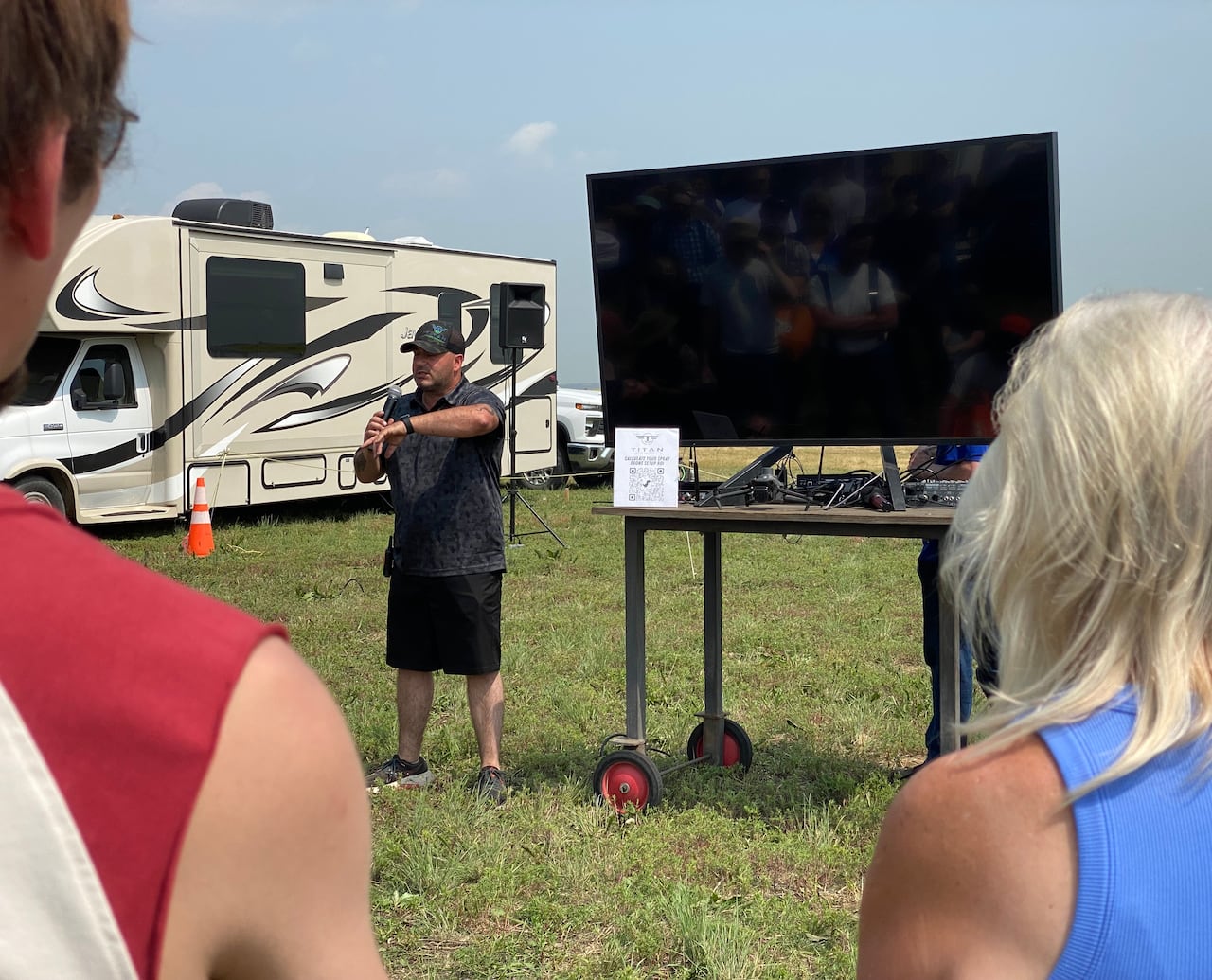
Ryan Crumly, a salesman for Titan Aero Drones, addresses attendees at the Ag In Motion convention regarding spray drones on July 22, 2026, in Langham, Sask. (Maia Tustonic/CBC)
Even with narrow tires, ground sprayers can damage 22 to 24 acres of crops during operation, Hill explained. This could result in a loss of nearly $15,000 in canola crops. Drones would not face this challenge.
“It doesn’t take long to justify the cost of the drone,” Hill remarked.
How quick will the uptake be?
Spray drones can run into the tens of thousands of dollars. However, this is relatively inexpensive compared to ground sprayers, which can exceed hundreds of thousands, according to Crumly.
The operational expenses are also lower — approximately 83 cents per acre for a drone, contrasted with $10.50 per acre for a high-clearance ground sprayer.
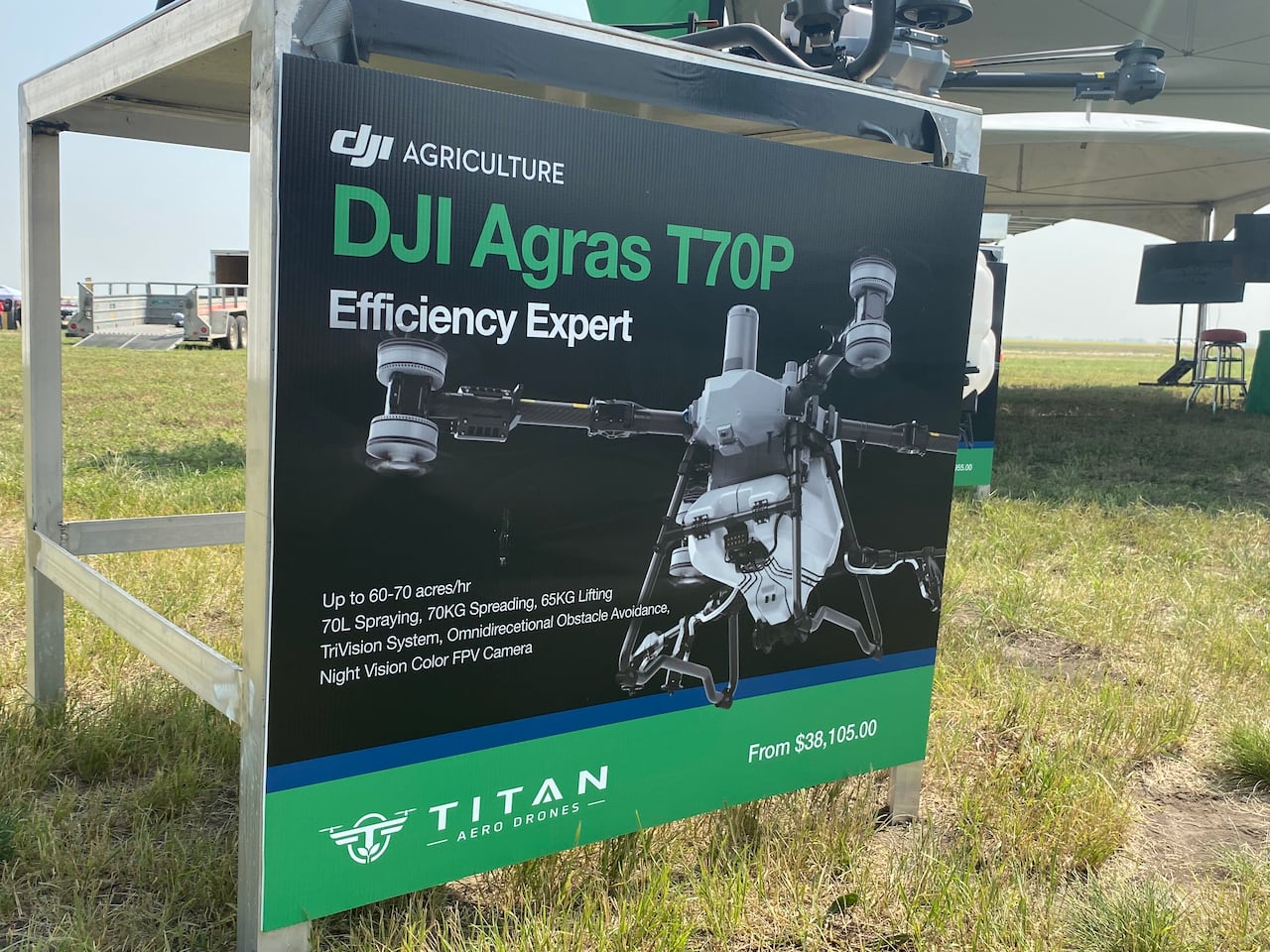
A display poster exhibits a spray drone at the Ag In Motion convention in Langham, Sask. on July 22, 2026. The price begins above $38,000. (Maia Tustonic/CBC)
Nevertheless, farmers are still cautious regarding the investment.
“Probably my biggest concern is that my bank account isn’t quite sufficient yet,” Hill admitted.
Although he acknowledges that drones represent “the future,” Hill believes the technology may not yet be capable of covering large areas at once and likely requires further refinement. Nonetheless, he is seriously contemplating a purchase.
-
2 Sask. research farms slated to close will now stay open
-
Sask. farmers long for warmer days as crops suffer from severe weather
Raymond Phillips, an Alberta farmer located northwest of Lloydminster, is also monitoring advancements in this technology. He is aware of the potential costs involved beyond just the initial purchase price.
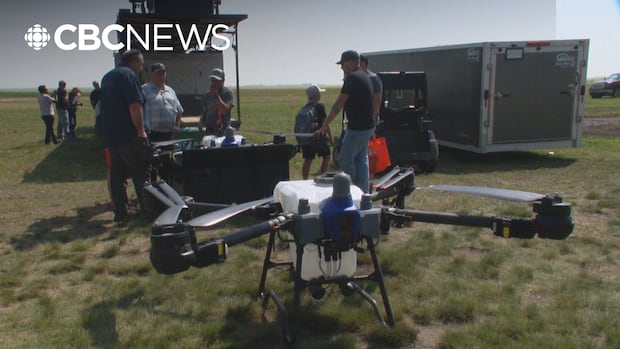
Health Canada lifted its restrictions to allow drones to spray pesticides at the end of June. Since then, dealers and farmers say there’s been a surge of interest in the technology.
“You require a mixing system, a generator, and a pilot’s license,” he pointed out. “There are numerous components to consider before deciding, yes, I’m purchasing one today.”
However, Phillips envisions acquiring one within the next two to three years.
“They’re still in the development phase,” he commented. “But I believe it’s a trend that is on the horizon.”